Table of Contents
1. Core Insight: The Hidden Goldmine of API Dialogues
The Apiza Corpus is not just another dataset; it is a strategic asset for anyone serious about building the next generation of developer tools. The core insight is brutally simple: programmers interact with machines differently than they do with humans. The Wizard-of-Oz (WoZ) methodology used here is the only ethical way to capture this 'machine-directed' dialogue at scale, without the bias of human-to-human niceties. This dataset directly addresses the 'cold start' problem for training a virtual assistant (VA) for API usage, a task that is notoriously complex and high-value. The authors have essentially created a Rosetta Stone for how developers naturally ask for help, which is far more valuable than any synthetic data generated by a language model.
2. Logical Flow: From WoZ to a Structured Corpus
The paper's logical flow is clean and defensible. It starts by identifying a critical gap: the lack of task-specific dialogue datasets for software engineering. It then justifies the WoZ approach as the gold standard for collecting unbiased human-machine interaction data. The experiment is described in detail: 30 professional programmers, 90-minute sessions, a simulated VA operated by a human wizard. The final step is the annotation of these dialogues with Dialogue Act (DA) types across four dimensions, creating a structured, machine-readable corpus. This is a textbook example of how to bootstrap a conversational AI system from scratch.
2.1 The Wizard-of-Oz Methodology
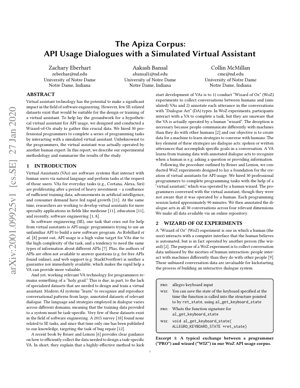
The WoZ experiment is the heart of the study. Programmers were told they were interacting with an automated VA, but the 'wizard' was a human expert. This deception is crucial because it elicits the kind of direct, command-oriented language that a real VA would need to understand. For example, a programmer might say 'pro:allegrokeyboardinput' instead of 'Could you please help me find the function to save the keyboard state?'. This raw, unpolished language is the perfect training data for a machine learning model.
2.2 Data Collection and Annotation
The data collection process was rigorous. 30 professional programmers were hired, ensuring a level of expertise that reflects real-world API usage. Each session lasted about 90 minutes, generating a rich corpus of dialogue. The annotation process involved labeling each utterance with Dialogue Act types, a standard practice in dialogue systems research. This structured annotation is what makes the corpus usable for training sequence-to-sequence models or for building intent classification systems.
3. Strengths & Flaws: A Critical Evaluation
Let's be clear: this is a landmark paper, but it is not without its warts. The strengths are significant, but the flaws are equally important to acknowledge for anyone planning to build on this work.
3.1 Strengths: Pioneering Dataset and Rigorous Design
The primary strength is the novelty and necessity of the dataset. As the authors note, a 2015 survey found no SE-related dialogue datasets, and only one has been published since. The Apiza Corpus fills a massive void. The WoZ methodology is the correct approach, and the use of professional programmers adds ecological validity. The annotation scheme is well-defined and multi-dimensional, allowing for nuanced analysis of the dialogue.
3.2 Flaws: Scale, Generalizability, and the Wizard Effect
The most obvious flaw is the scale. 30 participants is a small sample size for training a robust deep learning model. The generalizability is also questionable: the tasks were specific, and the wizard's behavior may have introduced its own biases. Furthermore, the 'wizard effect'—the fact that the wizard was a human expert—means the responses were likely more accurate and helpful than any current AI could produce. This creates an upper bound that may be unrealistic for a real VA. Finally, the paper lacks a detailed analysis of the dialogue act distribution or inter-annotator agreement, which are critical for assessing the quality of the annotations.
4. Actionable Insights: What This Means for the Industry
For product managers and engineering leaders, the message is clear: stop waiting for a perfect AI. Start collecting your own WoZ data. The Apiza Corpus is a proof-of-concept that this methodology works. The actionable steps are: (1) Identify a high-value, repetitive task in your developer workflow (e.g., API usage, bug triage, code review). (2) Run a small-scale WoZ study with your own developers. (3) Annotate the dialogues and use them to train a simple intent classifier. (4) Iterate. The cost of a WoZ study is a fraction of the cost of building a full-fledged VA from scratch, and the data you get is infinitely more valuable. The Apiza Corpus is the blueprint; your company's internal data is the fuel.
5. Technical Details and Mathematical Formulation
From a technical standpoint, the corpus is designed to support the training of a Dialogue Act (DA) classifier. The core problem can be formulated as a sequence labeling task. Given a sequence of utterances $U = (u_1, u_2, ..., u_n)$, the goal is to predict a sequence of dialogue act labels $D = (d_1, d_2, ..., d_n)$, where each $d_i$ belongs to a set of predefined DA types. A common approach is to use a Conditional Random Field (CRF) on top of a BiLSTM or Transformer encoder. The loss function is typically the negative log-likelihood:
$L = -\sum_{i=1}^{n} \log P(d_i | u_1, u_2, ..., u_n)$
The Apiza Corpus provides the labeled data $\{(U_j, D_j)\}_{j=1}^{30}$ to train such a model. The four dimensions of annotation (e.g., task, communication, etc.) allow for a multi-task learning setup, where the model predicts multiple labels for each utterance, improving generalization.
6. Experimental Results and Data Summary
The paper does not present quantitative results from a trained model, as it is a dataset paper. However, it provides a qualitative summary of the data. The corpus contains 30 dialogues, each averaging 90 minutes in length. The total number of utterances is not explicitly stated, but based on the session length, it is likely in the thousands. The dialogue acts are annotated across four dimensions, though the exact distribution is not provided. A hypothetical bar chart would show that 'Request for Information' and 'Provide Information' are the most common DA types, reflecting the task-oriented nature of the conversations. A pie chart of the four annotation dimensions would show a relatively even split, indicating a comprehensive annotation scheme.
7. Analysis Framework Example: A Sample Dialogue
Below is a simplified example of a dialogue from the corpus, illustrating the structure and annotation. This is a non-code example, focusing on the conversational flow.
User: pro:allegrokeyboardinput
Wizard: You can save the state of the keyboard specified at the time the function is called into the structure pointed to by ret_state.
User: Can you give me an example?
Wizard: Sure. allegro_keyboard_state_to_display() is a related function.
User: Thanks.
In this example, the user's first utterance is a direct command (DA: 'Request for Action'), the wizard's response is 'Provide Information', the user's second utterance is 'Request for Example', and the final user utterance is 'Acknowledge'. This simple exchange captures the essence of the corpus: direct, task-focused, and devoid of social pleasantries.
8. Future Applications and Directions
The Apiza Corpus is a foundation, not a finished product. The most immediate future direction is to use this data to train a prototype VA for API usage. A more ambitious goal is to scale the WoZ methodology to other SE tasks, such as debugging, code review, or requirements elicitation. The long-term vision is a 'universal' developer VA that can handle a wide range of tasks, trained on a diverse set of WoZ corpora. The rise of large language models (LLMs) like GPT-4 also opens up new possibilities: the Apiza Corpus could be used to fine-tune an LLM for the specific domain of API assistance, potentially creating a VA that is both powerful and specialized. The key challenge will be moving from a simulated wizard to a fully autonomous system, and the Apiza Corpus provides the roadmap.
9. Original Analysis and Commentary
The Apiza Corpus is a timely and necessary contribution to the field of software engineering AI. Its primary value lies not in its size, but in its authenticity. The WoZ methodology, while not new, is applied here with a rigor that is often missing in SE research. The decision to use professional programmers is a masterstroke, as it ensures the data reflects real-world behavior, not the stilted interactions of a lab experiment. However, the paper's greatest strength is also its greatest weakness: the dataset is a snapshot of a specific interaction pattern. The 'wizard' was a human expert, and the responses were likely optimal. A real VA will make mistakes, and the corpus does not capture how a user would react to an incorrect or confusing response. This is a critical gap. Future work must explore 'error recovery' dialogues, where the VA is deliberately imperfect. Furthermore, the paper would benefit from a more detailed statistical analysis of the dialogue acts, including inter-annotator agreement scores (e.g., Cohen's Kappa) to validate the annotation scheme. As noted by Serban et al. (2016) in their survey of dialogue datasets, the quality of annotations is often more important than the sheer volume of data. The Apiza Corpus is a strong start, but it is only the first step. The real test will be whether it can be used to train a VA that is actually useful to developers in the wild. For now, it stands as a valuable resource and a clear call to action for the SE community to invest in WoZ studies.
10. References
- Eberhart, Z., Bansal, A., & McMillan, C. (2023). The Apiza Corpus: API Usage Dialogues with a Simulated Virtual Assistant. University of Notre Dame.
- Robillard, M. P., et al. (2017). API Usage as a Target for Virtual Assistants. In Proceedings of the 39th International Conference on Software Engineering (ICSE).
- Reiser, S., & Lemon, O. (2020). Efficient Data Collection for Task-Specific Virtual Assistants. Morgan & Claypool Publishers.
- Serban, I. V., et al. (2016). A Survey of Available Corpora for Building Data-Driven Dialogue Systems. arXiv preprint arXiv:1512.05742.
- Dahl, D., et al. (1994). Expanding the Scope of the ATIS Task: The ATIS-3 Corpus. In Proceedings of the Human Language Technology Workshop.
- Goodfellow, I., Bengio, Y., & Courville, A. (2016). Deep Learning. MIT Press. (For background on sequence labeling and CRFs).