2.1 Dialogue Coherence and Salience
Maintaining a logically consistent and topically relevant conversation over multiple turns. Without commonsense, models generate responses that are syntactically correct but semantically absurd or irrelevant.
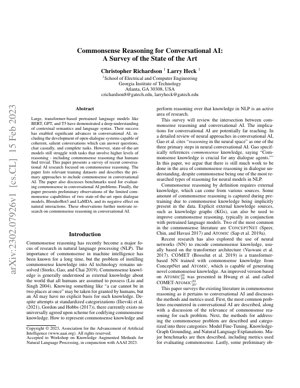
This survey paper addresses the critical challenge of integrating commonsense reasoning into modern conversational AI systems. While large pretrained language models (e.g., BERT, GPT, T5) have achieved remarkable success in understanding syntax and context, they fundamentally lack the implicit, worldly knowledge that humans take for granted. The paper argues that this gap is a primary bottleneck preventing AI from engaging in truly natural, coherent, and intelligent dialogue. The authors, Christopher Richardson and Larry Heck from Georgia Tech, position their work as a necessary mapping of the current landscape—methods, datasets, and evaluation—to guide future research in this nascent but vital field.
The paper delineates specific conversational tasks where commonsense failure is most apparent.
Maintaining a logically consistent and topically relevant conversation over multiple turns. Without commonsense, models generate responses that are syntactically correct but semantically absurd or irrelevant.
Answering questions or completing instructions that require unstated assumptions. For example, understanding that "boil the kettle" implies the subsequent step is "pour the water," even if not explicitly stated.
Understanding humor, sarcasm, empathy, and social norms. This requires a deep model of human psychology and social conventions that current models largely infer statistically rather than understand.
The survey categorizes the primary technical approaches explored in the literature.
Further training large language models (LLMs) on datasets rich in commonsense knowledge (e.g., ATOMIC, SocialIQA). This approach aims to bake commonsense into the model's parameters implicitly.
Explicitly connecting the model to structured knowledge bases like ConceptNet or ATOMIC. The model retrieves or reasons over these graphs during inference. A key example is COMET (Bosselut et al., 2019), a transformer model trained to generate new knowledge tuples from these graphs.
Training models to generate not just an answer but also a reasoning trace or explanation in natural language. This forces the model to articulate the implicit steps, potentially improving robustness.
Beyond standard accuracy, the field uses metrics like:
The authors present critical, hands-on analysis of leading open-dialogue models, BlenderBot 3 and LaMDA. Their observations are damning: despite these models' scale and sophistication, they frequently fail at trivial commonsense tasks. Examples include generating contradictory statements within a conversation or failing to understand basic physical constraints. This empirical evidence powerfully underscores the paper's central thesis: benchmark performance does not equate to robust, usable commonsense in open-ended interaction.
Core Insight: The conversational AI field is suffering from a severe "commonsense debt." We've built skyscrapers (massive LLMs) on shaky, implicit foundations. The survey correctly identifies that the core issue isn't a lack of techniques, but a fundamental mismatch between the statistical, pattern-matching nature of modern NLP and the symbolic, causal, and analogical nature of human commonsense. As noted in the seminal work "On the Measure of Intelligence" by Chollet (2019), true intelligence requires skill acquisition and generalization in novel situations—a feat impossible without a rich model of the world.
Logical Flow: The paper's structure is logical and persuasive. It moves from defining the problem and its manifestations (Sections 1-2), to cataloging the engineering solutions attempted (Section 3), to examining how we measure progress (Section 4), and finally providing concrete evidence that current solutions are inadequate (Section 5). This flow mirrors the scientific method: hypothesis (commonsense is missing), experimentation (various integration methods), measurement (benchmarks), and conclusion (not solved).
Strengths & Flaws: The paper's greatest strength is its concrete, critical evaluation of SOTA models. It moves beyond academic abstractions to show real failure modes. Its primary flaw, common to surveys, is its descriptive rather than prescriptive nature. It maps the territory but offers limited guidance on which paths are most promising. It underplays the architectural limitations of pure transformer-based models for causal reasoning, a point heavily emphasized in research from institutions like MIT's CSAIL on neuro-symbolic integration.
Actionable Insights: For practitioners and researchers, the takeaway is clear: stop treating commonsense as just another dataset to fine-tune on. The field needs a paradigm shift. 1) Invest in Neuro-Symbolic Architectures: Hybrid models that combine neural networks with explicit, manipulable knowledge representations (like the work on Differentiable Inductive Logic Programming) are a necessary direction. 2) Develop Better Simulated Environments: Like OpenAI's Gym for reinforcement learning, we need rich, interactive simulators (inspired by platforms like AllenAI's THOR) where agents can learn commonsense through embodied experience and consequence, not just text. 3) Rethink Evaluation: Move from static QA benchmarks to dynamic, interactive evaluation where models must demonstrate consistent world understanding over time, similar to the principles behind the ARC (Abstraction and Reasoning Corpus) challenge.
The knowledge-graph grounding approach often involves a retrieval-augmented generation framework. Formally, given a dialogue context $C$, the model retrieves a set of relevant commonsense knowledge tuples $K = \{(h_i, r_i, t_i)\}$ from a knowledge graph $\mathcal{G}$, where $h$ is a head entity, $r$ a relation, and $t$ a tail entity. The final response $R$ is generated by conditioning on both $C$ and $K$:
$P(R | C) \approx \sum_{K} P_{\text{retrieve}}(K | C) \cdot P_{\text{generate}}(R | C, K)$
Models like COMET implement this by fine-tuning a transformer (e.g., GPT-2) to predict the tail entity $t$ given $(h, r)$, effectively learning to traverse the graph in a latent space: $t = \text{COMET}(h, r)$.
While the PDF preview does not contain explicit charts, the described preliminary observations imply a significant performance gap. We can conceptualize a hypothetical bar chart comparing human performance versus BlenderBot3 and LaMDA on a suite of commonsense dialogue tasks (e.g., Coherence, Physical Reasoning, Social Reasoning). The Y-axis would represent a score (0-100). The chart would show:
Scenario: Evaluating a conversational agent's understanding of a simple narrative.
Dialogue Context: User: "I just got a new puppy! He's so energetic. I left him in the living room with my favorite shoes while I answered the door."
Agent Response A (Lacking Commonsense): "That's nice. What color are your shoes?"
Agent Response B (With Commonsense): "Oh no, you might want to check on those shoes! Puppies love to chew."
Framework Analysis:
Solving commonsense reasoning will unlock transformative applications: