1. Introduction & Overview
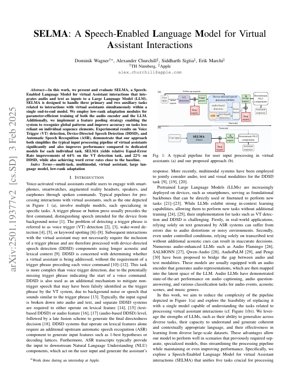
This document analyzes the research paper "SELMA: A Speech-Enabled Language Model for Virtual Assistant Interactions." The work presents SELMA, a novel multimodal system designed to streamline and enhance the processing pipeline for voice-activated virtual assistants (VAs). Traditional VA pipelines, as depicted in Figure 1(a) of the paper, are complex, involving multiple specialized models for sequential tasks like Voice Trigger (VT) detection, Device-Directed Speech Detection (DDSD), and Automatic Speech Recognition (ASR). This modular approach often leads to error propagation, latency, and increased computational overhead.
SELMA proposes a paradigm shift by integrating audio and text inputs into a single, end-to-end Large Language Model (LLM). It is trained to handle three primary tasks—VT detection, DDSD, and ASR—simultaneously within one unified model. The core innovation lies in its use of parameter-efficient fine-tuning techniques, specifically Low-Rank Adaptation (LoRA), applied to both the audio encoder and the LLM backbone. This allows SELMA to leverage the powerful contextual understanding of LLMs while being adaptable to multimodal inputs with minimal trainable parameters.
Core Insight
SELMA replaces a fragmented, multi-model pipeline with a single, unified LLM, achieving superior performance and architectural simplicity for core virtual assistant tasks.
2. Methodology & Architecture
SELMA's architecture is built on a pre-trained LLM foundation. The system ingests both raw audio waveforms (processed by an audio encoder) and textual tokens. The key to its efficiency and effectiveness is the strategic integration of these modalities and the training approach.
2.1 Model Architecture
The model accepts a concatenated sequence of audio feature vectors (from the encoder) and text tokens. A shared transformer-based LLM processes this unified sequence. Task-specific output heads are attached to the LLM's final hidden states to generate predictions for VT, DDSD, and ASR concurrently. This contrasts sharply with the traditional pipeline shown in Figure 1(b), where separate models operate in sequence.
2.2 Low-Rank Adaptation (LoRA)
To fine-tune the massive LLM and audio encoder efficiently, SELMA employs LoRA. Instead of updating all weights, LoRA injects trainable rank decomposition matrices into the transformer layers. For a weight matrix $W \in \mathbb{R}^{d \times k}$, the update is represented as $W' = W + BA$, where $B \in \mathbb{R}^{d \times r}$, $A \in \mathbb{R}^{r \times k}$, and the rank $r \ll \min(d, k)$. This drastically reduces the number of trainable parameters, making it feasible to adapt large models to new multimodal tasks with limited data.
2.3 Feature Pooling Strategy
For tasks like VT and DDSD that require a global understanding of the utterance rather than per-token detail, SELMA implements a feature pooling mechanism (e.g., mean pooling) over the sequence of audio embeddings before feeding them into the LLM. This helps the model recognize overarching acoustic patterns crucial for detection tasks.
3. Experimental Results
The paper presents compelling experimental evidence of SELMA's superiority over traditional, task-specific models.
3.1 Performance Metrics
Key results are summarized below:
Voice Trigger (VT) Detection
64% rel. EER Improvement
Massive reduction in Equal Error Rate compared to dedicated VT models.
Device-Directed Speech (DDSD)
22% rel. EER Improvement
Significant gain in accurately detecting user intent without a trigger phrase.
Automatic Speech Recognition (ASR)
WER Close to Baseline
Maintains competitive Word Error Rate while performing other tasks.
3.2 Comparison with Baselines
SELMA was benchmarked against state-of-the-art dedicated models for each individual task. The results demonstrate that the unified model not only matches but often exceeds the performance of these specialized systems. This challenges the long-held assumption that task-specific models are inherently superior. The simplification from the pipeline in Figure 1(a) to SELMA's unified approach in Figure 1(b) comes with a clear performance upside, not a compromise.
4. Technical Analysis & Core Insights
Core Insight: The SELMA paper is a decisive strike against architectural bloat in edge AI. It proves that a single, properly conditioned LLM can outperform a Rube Goldberg machine of specialized models for tightly coupled tasks like VT, DDSD, and ASR. The industry has been clinging to a modular dogma for too long, and SELMA shows the path to consolidation.
Logical Flow: The argument is elegant: 1) Traditional pipelines are complex and prone to error cascades. 2) LLMs are powerful sequence models that can, in principle, handle multimodal sequences. 3) The bottleneck is efficient adaptation. 4) Solution: Use LoRA for parameter-efficient tuning and intelligent feature pooling to guide the model's attention. 5) Result: A simpler, better-performing system. The flow from problem to solution is coherent and well-supported by the data.
Strengths & Flaws: The primary strength is the dramatic performance improvement on detection tasks (64% and 22% EER gains are not trivial). Using LoRA is a smart, practical choice for on-device deployment, aligning with trends seen in other efficient AI research from institutions like Stanford's CRFM. The major flaw, which the authors acknowledge, is the inherent black-box nature of the LLM's decision-making for safety-critical tasks like VT. If the model fails, diagnosing *why* is harder than in a rule-based or simpler model. Furthermore, the training and data requirements for such a unified model are likely substantial, potentially creating a high barrier to entry.
Actionable Insights: For product teams, the message is clear: start prototyping unified, LLM-based backbones for multimodal interaction tasks. The era of stitching together five different models for a single user utterance is ending. The research priority should shift from building better isolated components to designing better training paradigms and evaluation benchmarks for these unified models, ensuring they are robust, interpretable, and fair. As seen in the evolution of models like GPT and BERT, the trajectory points toward generalization, not specialization, for core language (and now audio) understanding.
Analysis Framework Example: Evaluating Unified vs. Modular Systems
Scenario: A team is deciding between a SELMA-like unified model and a traditional modular pipeline for a new smart speaker.
Framework Application:
- Performance: Compare EER for VT/DDSD and WER for ASR on in-domain and noisy out-of-domain data. SELMA likely wins on integrated tasks.
- Latency & Compute: Profile end-to-end latency and memory footprint. The unified model may have lower latency due to fewer serial steps but may require more memory for the LLM.
- Development & Maintenance: Assess the cost of training/maintaining one complex model vs. 3-5 simpler ones. Unified models simplify the codebase but require deep LLM expertise.
- Safety & Debugging: Evaluate the ease of adding safeguards or diagnosing failures. Modular systems offer more control points.
5. Future Applications & Directions
SELMA's approach has implications beyond virtual assistants. The core concept of a multimodal LLM serving as a unified interface for sequential perception tasks is generalizable.
- Extended Multimodality: Future iterations could incorporate visual inputs (e.g., from AR glasses) for context-aware interaction, determining if a user is looking at the device when speaking.
- Proactive Assistance: By continuously processing ambient audio/text (with appropriate privacy guards), such models could move from reactive command execution to proactive suggestion, similar to the vision behind Google's Ambient Computing.
- Cross-Domain Generalization: The architecture could be adapted for other domains requiring sequential multimodal understanding, such as video content moderation (audio+visual+text) or automotive voice interfaces fused with driver monitoring systems.
- On-Device Learning: Future work must address personalization and continuous learning on the device using techniques like replay buffers or federated learning, adapting the unified model to individual user speech patterns and vocabulary without compromising privacy.
- Efficiency Frontiers: Research will push towards even more efficient base models (e.g., based on Mixture of Experts architectures) and adaptation techniques beyond LoRA to make these powerful unified models viable on the most resource-constrained edge devices.
6. References
- Hu, E. J., et al. "LoRA: Low-Rank Adaptation of Large Language Models." arXiv preprint arXiv:2106.09685 (2021).
- Radford, A., et al. "Robust Speech Recognition via Large-Scale Weak Supervision." Proceedings of ICML (2023).
- Bommasani, R., et al. "On the Opportunities and Risks of Foundation Models." Stanford University Center for Research on Foundation Models (CRFM) (2021).
- Brown, T., et al. "Language Models are Few-Shot Learners." Advances in Neural Information Processing Systems 33 (2020).
- Vaswani, A., et al. "Attention is All You Need." Advances in Neural Information Processing Systems 30 (2017).
- Google AI Blog. "The Path to Ambient Computing." (2020). [Online]. Available: https://blog.google/products/assistant/path-ambient-computing/