Table of Contents
- 1. Introduction & Overview
- 2. Background & Core Concepts
- 3. Benefits of Conversational AI
- 4. Methodology of the Survey
- 5. Results: State-of-the-Art Models
- 6. Results: Gender Analysis of Conversational AI
- 7. Existing Challenges & Limitations
- 8. Low-Resource Language Challenges
- 9. Related Work & Previous Surveys
- 10. Critical Analyst Review
- 11. Technical Details & Mathematical Framework
- 12. Experimental Results & Data Analysis
- 13. Analysis Framework: Case Study Example
- 14. Future Applications & Research Directions
- 15. References
1. Introduction & Overview
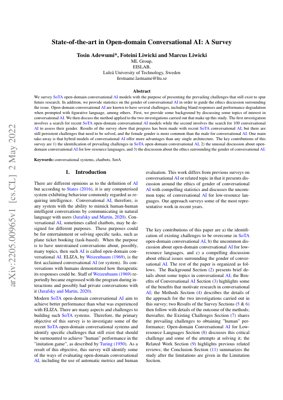
This analysis is based on the survey paper "State-of-the-art in Open-domain Conversational AI: A Survey" by Adewumi, Liwicki, and Liwicki. The primary objective of the original survey is to investigate recent state-of-the-art (SoTA) open-domain conversational AI models, identify persistent challenges, and spur future research. A unique aspect is its investigation into the gender distribution of conversational AI agents, providing data to guide ethical discussions.
The survey defines conversational AI as any system capable of mimicking human-human intelligent conversations using natural language. It traces the lineage back to ELIZA (Weizenbaum, 1969) and aims to assess progress towards achieving "human" performance in the Turing test paradigm.
Key Contributions Identified:
- Identification of prevailing challenges in SoTA open-domain conversational AI.
- Discussion on open-domain conversational AI for low-resource languages.
- Analysis of ethical issues surrounding the gender of conversational AI, supported by statistics.
2. Background & Core Concepts
The field encompasses systems designed for various purposes: task-oriented (e.g., booking tickets) and open-domain (unrestricted conversation on many topics). The survey focuses on the latter, which presents unique challenges in coherence, engagement, and knowledge grounding compared to narrow-task bots.
Modern approaches often leverage large language models (LLMs), sequence-to-sequence architectures, and retrieval-based methods, sometimes combined in hybrid systems.
3. Benefits of Conversational AI
The survey highlights motivations for research, including:
- Entertainment & Companionship: Providing social interaction and engagement.
- Information Access: Enabling natural language interfaces to vast knowledge.
- Therapeutic Applications: As demonstrated by early systems like ELIZA.
- Research Benchmark: Serving as a testbed for AI capabilities in natural language understanding and generation.
4. Methodology of the Survey
The paper conducts two main investigations:
- SoTA Model Search: A systematic search for recent (presumably within a few years of publication) SoTA open-domain conversational AI models in academic literature.
- Gender Assessment: A search and analysis of 100 conversational AI systems (likely including commercial chatbots, voice assistants, and research prototypes) to categorize their perceived or assigned gender.
The method appears to be a qualitative survey and meta-analysis rather than a quantitative benchmarking study.
5. Results: State-of-the-Art Models
The survey finds that while significant progress has been made since early rule-based systems, persistent challenges remain. A key conclusion is the advantage of hybrid models that combine different architectural paradigms (e.g., retrieval and generation, or symbolic and neural approaches) over any single architecture.
Progress is noted in areas like fluency and basic coherence, but fundamental issues in depth, consistency, and handling figurative language persist.
6. Results: Gender Analysis of Conversational AI
This is a standout contribution of the survey. The analysis of 100 conversational AIs reveals a significant skew:
Gender Distribution in Conversational AI
Finding: The female gender is more commonly assigned or embodied by conversational AI agents than the male gender.
Implication: This reflects and potentially reinforces societal biases and stereotypes, often casting AI in subservient or assistant roles traditionally associated with femininity. It raises critical ethical questions about design choices and their social impact.
7. Existing Challenges & Limitations
The survey identifies several key hurdles preventing "human-like" performance:
- Bland and Generic Responses: Tendency to produce safe, uninteresting, or non-committal replies.
- Figurative Language Failure: Difficulty understanding and generating metaphors, sarcasm, and idioms.
- Lack of Long-term Consistency & Memory: Inability to maintain a coherent persona and remember facts across long conversations.
- Evaluation Difficulties: Lack of robust, automatic metrics that correlate well with human judgment of conversation quality.
- Safety & Bias: Potential to generate harmful, biased, or inappropriate content.
8. Low-Resource Language Challenges
The survey importantly highlights the disparity in AI development. Most SoTA models are built for high-resource languages like English. For low-resource languages, challenges are magnified due to:
- Scarcity of large-scale conversational datasets.
- Lack of pre-trained language models.
- Unique linguistic structures not addressed by models designed for English.
The survey discusses some attempts to address this, such as cross-lingual transfer learning and focused data collection efforts.
9. Related Work & Previous Surveys
The authors position their work as distinct by combining the technical survey with the novel ethical investigation into gender and the focus on low-resource languages. It builds upon prior surveys that may have focused more narrowly on architectures, datasets, or evaluation methods.
10. Critical Analyst Review
Core Insight: This survey successfully exposes the uncomfortable truth that conversational AI's technical adolescence is matched by its ethical naivety. The field is racing towards capability benchmarks while largely sleepwalking into reinforcing harmful social stereotypes, as starkly evidenced by the female-gender skew. The advocacy for hybrid models is less a breakthrough and more an admission that the monolithic LLM path has fundamental, uncanny-valley-type limits.
Logical Flow: The paper's structure is effective: establish the technical landscape, reveal the systemic gender bias within it, and then connect this to the broader challenges of blandness and inequity (e.g., low-resource languages). This creates a compelling narrative that technical and ethical challenges are intertwined, not separate tracks. However, it could more forcefully link the bias in training data (often scraped from the internet, which contains societal biases) directly to the bland response problem—both are symptoms of optimizing for the "average" rather than the "good."
Strengths & Flaws:
Strengths: The gender analysis is a brave and necessary inclusion, providing hard data for a often-speculative debate. Highlighting low-resource languages is crucial for inclusive AI development. The focus on persistent, unsolved challenges is more valuable than a mere list of model achievements.
Flaws: As a survey, its depth on any single technical challenge is limited. The methodology for the gender analysis (how "gender" was determined for 100 AIs) needs more explicit description for reproducibility. It somewhat underplays the seismic impact of post-survey developments like ChatGPT, which, while not solving the core challenges, has shifted the public and research paradigm dramatically.
Actionable Insights: 1) Audit & Diversify: Development teams must implement mandatory bias and diversity audits for training data and model outputs, moving beyond ad-hoc red-teaming. 2) Value-Sensitive Design: Adopt frameworks like Value-Sensitive Design (Friedman & Kahn, 2003) from the project's inception, explicitly deciding on persona gender (or lack thereof) as a core design requirement, not an afterthought. 3) Hybrid as Default: The research community should treat the hybrid model approach not as an option but as the default architecture, investing in novel ways to integrate symbolic reasoning, knowledge graphs, and affective computing with LLMs. 4) Global Benchmarks: Create and incentivize participation in benchmarks for low-resource language conversational AI, similar to the BLOOM project's (BigScience, 2022) ethos of large-scale multilingual model creation.
11. Technical Details & Mathematical Framework
While the survey is high-level, the core of modern conversational AI often involves sequence-to-sequence learning and transformer-based language modeling.
Transformer Architecture: The self-attention mechanism is key. For a sequence of input embeddings $X$, the output is computed via multi-head attention:
$\text{Attention}(Q, K, V) = \text{softmax}\left(\frac{QK^T}{\sqrt{d_k}}\right)V$
where $Q, K, V$ are query, key, and value matrices derived from $X$.
Response Generation: Given a dialogue history $H = \{u_1, u_2, ..., u_{t-1}\}$, the model generates a response $u_t$ by estimating the probability distribution:
$P(u_t | H) = \prod_{i=1}^{|u_t|} P(w_i | w_{ where $w_i$ are the tokens of the response. This is typically optimized using maximum likelihood estimation (MLE). Hybrid Model Loss: A hybrid retrieval-generation model might combine losses: $\mathcal{L}_{\text{total}} = \lambda \mathcal{L}_{\text{retrieval}} + (1-\lambda) \mathcal{L}_{\text{generation}}$ where $\lambda$ controls the weighting between selecting a candidate response from a knowledge base ($\mathcal{L}_{\text{retrieval}}$) and generating one from scratch ($\mathcal{L}_{\text{generation}}$).
12. Experimental Results & Chart Description
Chart: Hypothetical Gender Distribution of 100 Conversational AIs
Based on the survey's finding of a female-gender skew.
- X-axis: Gender Category (Female, Male, Gender-neutral/Unspecified, Other).
- Y-axis: Number of AI Agents (Count).
- Bars:
- Female: Tallest bar (e.g., ~65 agents). This represents the majority, including many commercial voice assistants and chatbots designed with female names and voices.
- Male: Shorter bar (e.g., ~25 agents). Includes some enterprise or "knowledgeable" assistants.
- Gender-neutral/Unspecified: A small bar (e.g., ~8 agents). Represents a growing but still minor trend.
- Other: Smallest bar (e.g., ~2 agents). Could represent non-human or explicitly customizable personas.
Interpretation: The chart visually demonstrates a significant imbalance, providing quantitative support for concerns about AI reinforcing gender stereotypes. The dominance of the "Female" category is the key experimental result driving the ethical discussion in the paper.
13. Analysis Framework: Case Study Example
Scenario: A company is developing a new open-domain companion chatbot for elderly users.
Applying the Survey's Insights - A Non-Code Framework:
- Challenge Identification (Sec. 7):
- Bland Responses: Risk of the bot giving repetitive, unengaging replies to stories.
- Memory: Must remember user's family details across sessions.
- Figurative Language: Needs to understand idioms common among older demographics.
- Architecture Decision (Sec. 5 & 11): Choose a hybrid model.
- Retrieval Component: A curated database of engaging stories, jokes, and reminiscence prompts.
- Generative Component (LLM): For flexible, context-aware dialogue.
- Memory Module: An external knowledge graph storing user-specific facts.
- The system uses a classifier (learned via $\lambda$ tuning) to decide when to retrieve vs. generate.
- Ethical & Inclusive Design (Sec. 6 & 8):
- Gender: Deliberately design a gender-neutral persona (voice, name, avatar). Conduct user studies to assess acceptance.
- Language: If targeting a multilingual region, plan for low-resource language support from the start using transfer learning techniques mentioned in Sec. 8, rather than as an add-on.
- Evaluation (Implied from Sec. 7): Go beyond automated metrics (e.g., perplexity). Implement longitudinal human evaluations with the target user group, measuring engagement, perceived empathy, and consistency over weeks of interaction.
14. Future Applications & Research Directions
Near-term Applications (1-3 years):
- Personalized Education & Tutoring: Open-domain tutors that adapt to student's conversational style and knowledge gaps.
- Advanced Customer Support: Moving beyond scripted FAQs to truly problem-solving conversations that blend task-orientation with rapport-building.
- Mental Health First Responders: Scalable, always-available conversational agents for initial support and triage, designed with rigorous ethical guardrails.
Critical Research Directions:
- Explainable & Controllable Dialogue: Developing models that can explain their reasoning and allow fine-grained control over personality, values, and factual grounding. Research from the DARPA XAI program (Gunning et al., 2019) provides a framework.
- Bias Mitigation & Fairness: Moving from identification to solution. Techniques like counterfactual data augmentation (Lu et al., 2020) or adversarial debiasing need adaptation for conversational tasks.
- Low-Resource & Inclusive AI: A major push for creating foundational conversational datasets and models for the world's languages, not just the top 5-10. The work of organizations like Masakhane and AI4Bharat is pivotal.
- Embodied & Multimodal Conversation: Integrating dialogue with perception and action in physical or virtual worlds, moving towards more situated and meaningful interaction.
- Long-term Relationship Modeling: Developing architectures capable of building and maintaining a consistent, evolving relationship with a user over months or years.
15. References
- Adewumi, T., Liwicki, F., & Liwicki, M. (Year). State-of-the-art in Open-domain Conversational AI: A Survey. [Source PDF].
- Weizenbaum, J. (1969). ELIZA—a computer program for the study of natural language communication between man and machine. Communications of the ACM.
- Turing, A. M. (1950). Computing machinery and intelligence. Mind.
- Jurafsky, D., & Martin, J. H. (2020). Speech and Language Processing (3rd ed.).
- Vaswani, A., et al. (2017). Attention is all you need. Advances in Neural Information Processing Systems.
- Friedman, B., & Kahn, P. H. (2003). Human values, ethics, and design. In The human-computer interaction handbook.
- BigScience Workshop. (2022). BLOOM: A 176B-Parameter Open-Access Multilingual Language Model. arXiv preprint arXiv:2211.05100.
- Gunning, D., et al. (2019). XAI—Explainable artificial intelligence. Science Robotics.
- Lu, K., et al. (2020). Counterfactual data augmentation for mitigating gender stereotypes in languages with rich morphology. Proceedings of the 58th Annual Meeting of the Association for Computational Linguistics.
- Zhu, J.-Y., et al. (2017). Unpaired image-to-image translation using cycle-consistent adversarial networks. Proceedings of the IEEE International Conference on Computer Vision. (Example of a seminal hybrid/cyclic architecture in a different domain).